
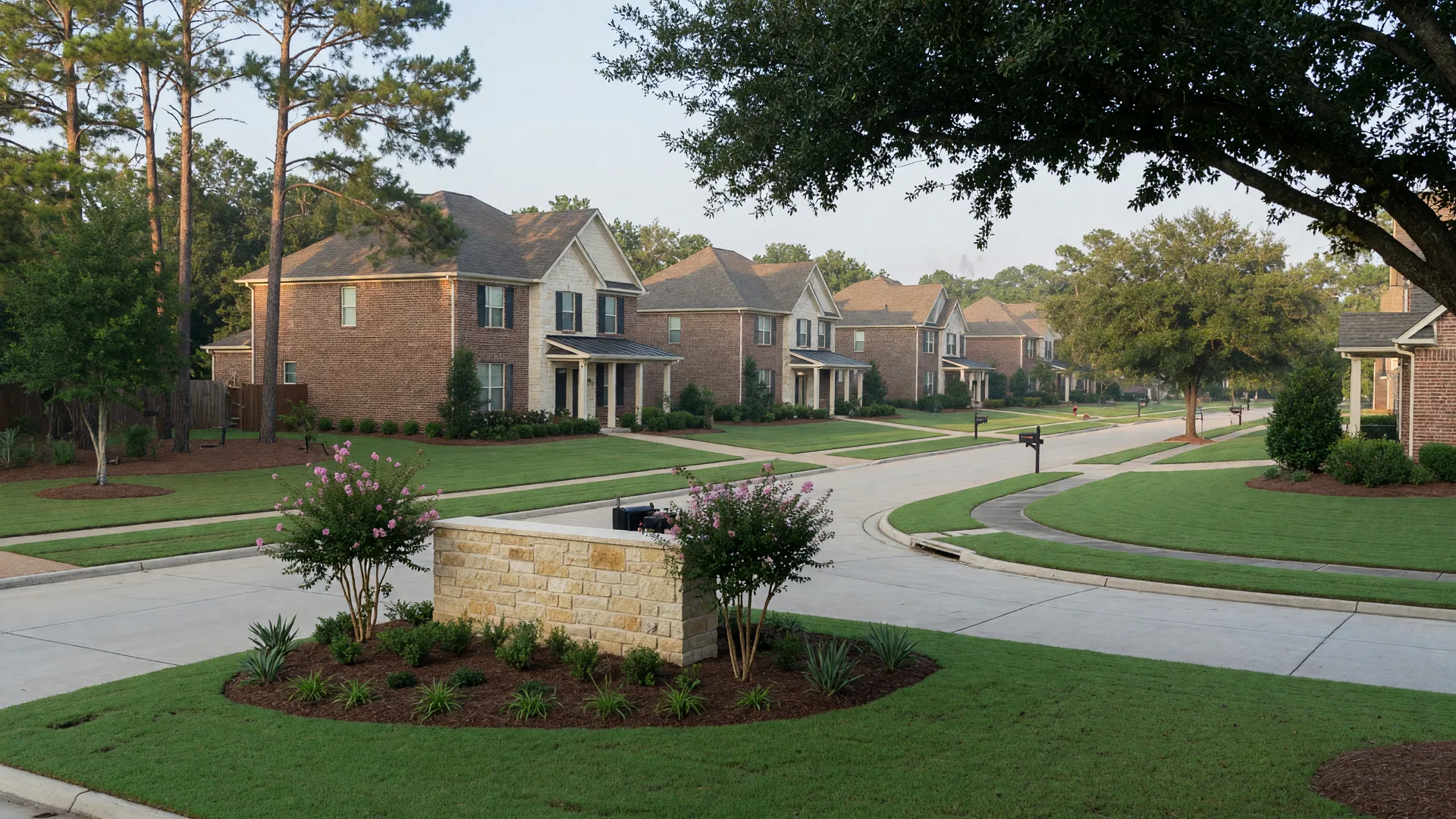
If you are buying a home in Kingwood, Humble, Atascocita, Porter, New Caney, Dayton, Crosby, or Huffman, the HOA fee is quietly part of almost every monthly payment you will write. Dues across the Northeast Houston area most commonly run from about $300 to $1,000 a year for single-family homes, and they can be higher in gated, amenity-heavy communities. This guide explains what those fees pay for, what they tend to cost in each town, and how to budget them before you make an offer.
Quick Answer:
HOA dues across the Northeast Houston area most often fall between $300 and $1,000 a year for single-family homes, with gated communities and amenity-rich master plans at the top of that range. The fee covers shared spaces such as entry monuments, pools, trails, and common-area insurance, not your roof or air conditioner. Always read the resale certificate before you commit, and run the full monthly payment with HOA dues, property taxes, and insurance before you compare one town to another.
Why the HOA fee belongs in your budget, not after it
It is easy to treat a few hundred dollars a year as pocket change, especially when you are focused on the purchase price. But the HOA fee is a permanent line item, and in Texas it sits alongside property taxes and homeowners insurance as part of the true cost of owning. A home listed at $320,000 in Porter with a $900 annual assessment costs materially more each month than a comparable home in a community with no HOA at all, and that difference matters when you are deciding between towns or between two homes on the same street.
The cleanest way to see this is to calculate the payment with everything included. Use my free Texas-specific payment calculator and add the HOA dues alongside taxes and insurance, and you get a monthly number you can actually compare against rent or against another home. My comfort range finder takes the reverse approach: it starts with the monthly budget you are comfortable with and tells you the home price that fits, so a $900-a-year association shows up as real dollars you cannot spend on the purchase price.
What HOA dues actually pay for
In the Northeast Houston area, most HOA fees pay for the things you see the moment you pull into a community: the stone entry monument at the gate, the landscaping along the main boulevards, the neighborhood pool and playground, the walking trails, and the streetlights in common areas. The association also carries insurance on those shared spaces and sets aside reserves to repave or replace them, which is why a well-funded association keeps a community looking sharp for decades.
What the HOA generally does not cover is your house. Your roof, air conditioner, foundation, and interior are yours, and in many communities your own lawn is too, which is why Kingwood looks like a forest with every yard trimmed. The association polices the deed restrictions that keep paint colors, fences, and front yards consistent, and in Texas those restrictions are governed by the state Property Code, so they travel with the property even if you never join a club. Read the rules before you buy, not after you get your first letter about the grass.
What fees look like town by town
Figures vary by community and change every year, so treat these as orientation ranges, not quotes. Confirm the current assessment with the association before you make an offer.
- In Kingwood, the village associations have reported annual fees in the $300 to $600 range in recent years, with Kingwood Service Association assessments added on top for the community-wide amenities that make The Livable Forest what it is. The exact number depends on your village, so ask for the current year's assessment. My Kingwood neighborhood guide walks through the villages one by one.
- In Atascocita, the Atascocita Community Improvement Association has published a roughly $400 annual assessment for 2026, and many neighborhoods such as Eagle Springs and Summerwood layer a community HOA on top, with reported figures around $780 to $825 a year. Gated sections with more amenities typically sit at the higher end.
- In Humble, the master-planned communities like Fall Creek have reported dues anywhere from around $500 to $1,000 a year, while older Humble neighborhoods often have no association at all. That split means two homes five minutes apart can have very different true monthly costs, so check each property individually. My Humble neighborhood guide covers both sides of that split.
- In Porter, master-planned communities such as Valley Ranch have reported assessments in the $700 to $1,000 range, and newer developments typically charge a few hundred dollars a year for entry and common-area upkeep. Newer communities in Porter also often carry MUD district taxes, which are a separate property tax line, not an HOA fee. My Porter neighborhood guide digs into the corridor and the districts.
- In New Caney, the fast-growing communities along the Grand Parkway generally carry modest annual assessments, and the new phases set their own fee levels as they build out. Some areas have older homes with no HOA, so the presence of an association can vary street by street.
- In Dayton, Crosby, and Huffman, newer subdivisions charge modest annual fees while older homes and acreage properties often have none. If the property sits on a larger lot, confirm whether the fee covers any common spaces at all before you assume what you are paying for.
The fee on a listing is not the fee at closing. Associations re-approve budgets each year, and new phases in growing communities sometimes raise assessments as amenities come online. The safest habit is to ask for the current year's assessment in writing, and to expect the number to move a little over the years you own the home.
Run the real numbers before you compare towns
A home with a $900 annual HOA adds roughly $75 to your monthly payment, and a gated community with a $1,200 fee adds about $100. That may not sound like much next to a mortgage, but it is real money you should decide to spend on purpose, not discover after you sign. When you compare a home in Kingwood against one in Humble or Porter, add the association dues, the property taxes, and the insurance quote to both sides before you trust the price tags.
My comfort range finder bakes the dues into the monthly budget so the price you target already leaves room for the association. And when you are close to an offer, my buyer cash to close breakdown shows the full cash you will bring to the table, including the prorated HOA dues and any transfer or processing fees the association charges at closing. Every calculator and guide lives in one place on the tools and resources hub if you want to work through them in order.
Questions every buyer should ask before signing
The single most important document is the resale certificate, the disclosure package the seller's association must provide before closing. In Texas it includes the declaration of covenants, the bylaws and rules, the financial statements, current and projected assessments, any unpaid dues on the property, and any pending special assessments. Texas law gives the association ten business days to deliver it after a verified written request and limits what it can charge, typically paid by the seller, so there is no reason to close without reading it.
Three other checks protect you. First, ask whether any special assessment has been voted or proposed, because a $10,000 roof replacement for a common building can land on your annual bill the month after you close. Second, have the title company verify there are no unpaid assessments or liens attached to the property, and confirm the seller pays the current year's dues through closing. Third, understand that Texas law limits what an association can collect: fines and collection costs alone are not enough to support a foreclosure, and foreclosures generally require a court order for unpaid assessments. Keep your dues current, and the association has very little leverage over you.
If you are selling a home inside an HOA
Sellers in Kingwood, Humble, and Atascocita should plan for the association too. Request the resale certificate early, clear any outstanding violations before the first showing, and pay the current year's dues so there are no last-minute surprises at closing. Buyers in the Northeast Houston area routinely ask about fees and rules before they make an offer, and a clean association file makes your home easier to sell. If you want to know what your home is worth in your specific community, request a free home valuation and I will give you a number based on your neighborhood and your property's condition.
The bottom line
HOA fees are a normal part of owning across the Northeast Houston area, and the range is wide: from a few hundred dollars a year in an older Humble neighborhood to $1,000 or more in a gated Porter or Atascocita community. The right choice is not the lowest fee, it is the fee that buys the lifestyle you actually want, whether that is Kingwood's trails, the pools and entry monuments of a master plan, or the freedom of no association at all on an acreage lot in Huffman or Crosby.
Start with the Northeast Houston overview to see the towns side by side, then run the payment math with the association dues included before you fall in love with a price tag.
Frequently Asked Questions
Does every home in Kingwood, Humble, Atascocita, Porter, New Caney, Dayton, Crosby, and Huffman have an HOA?
No. Master-planned communities and newer subdivisions in the Northeast Houston area almost always have an association, while older neighborhoods and acreage properties often have none. The presence of an HOA can vary street by street, so ask for the resale certificate or the seller's disclosure on every property you seriously consider.
How much are HOA fees in Kingwood?
Kingwood village associations have reported annual fees in the $300 to $600 range in recent years, with Kingwood Service Association assessments added on top for community-wide amenities. The total depends on your village, so confirm the current year's numbers with the association.
What exactly does the HOA fee cover?
The fee generally covers shared spaces: entry monuments, common landscaping, pools, playgrounds, trails, street lighting, and common-area insurance and reserves. It does not cover your roof, air conditioner, interior, or usually your own lawn, so read the declaration to see exactly what is included in your community.
What is a resale certificate and who pays for it?
It is the disclosure package the seller's association must provide before closing, including the rules, financial statements, current and projected assessments, and any unpaid dues on the property. Texas law caps what the association can charge for it, typically paid by the seller, so you should always get one and read it before you commit.
Can an HOA take your home in Texas?
An HOA can only foreclose on unpaid regular and special assessments, not on fines alone, and in Texas that type of foreclosure generally requires a court order. Keep your assessments current and review the resale certificate, and the association has very limited power over you.