
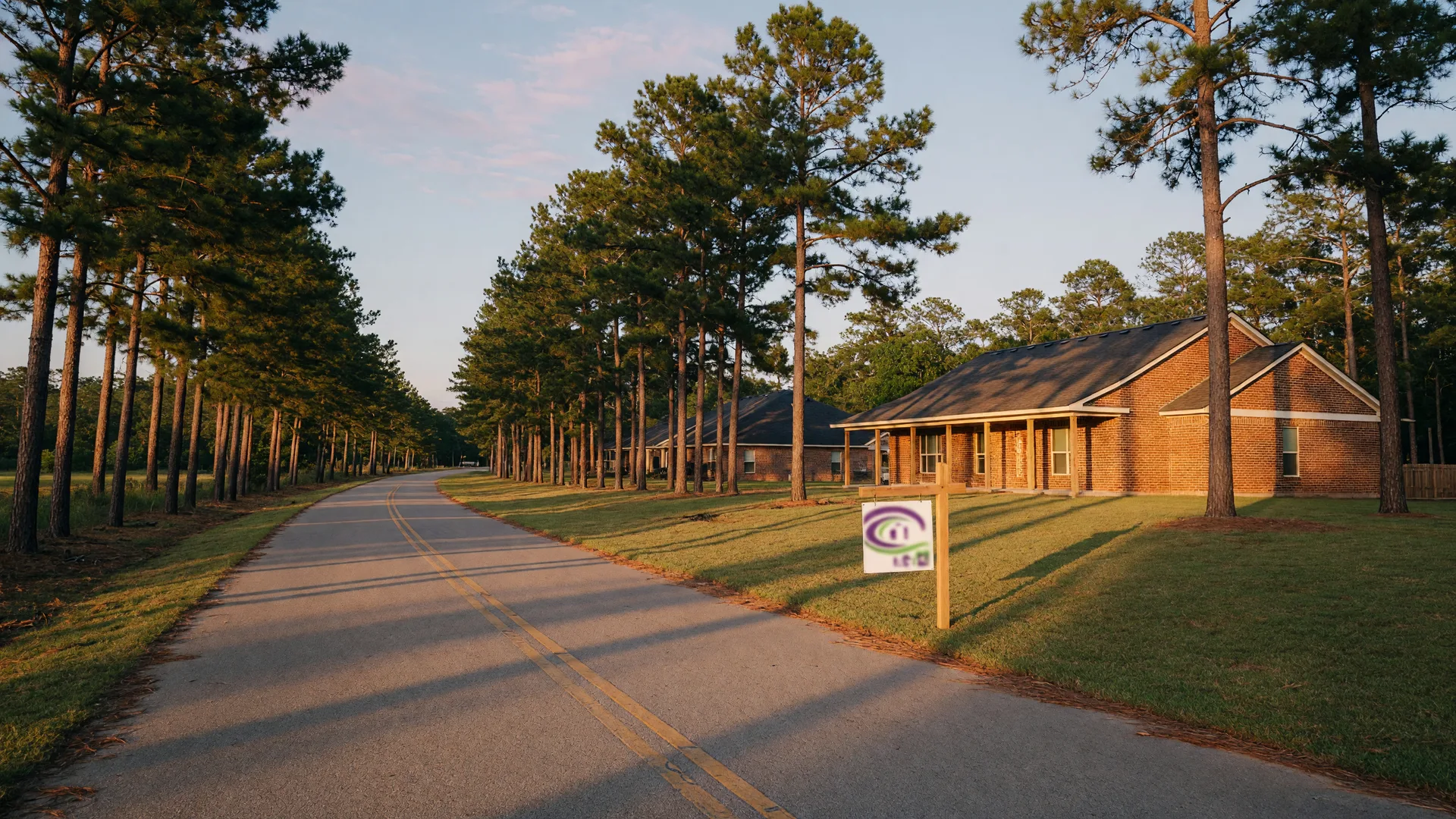
If you are buying a home in Dayton, Crosby, Huffman, Porter, or New Caney, a USDA Rural Development loan may let you buy with zero money down. The program offers 100 percent financing on primary residences in eligible areas, and large parts of the Northeast Houston area qualify, which is why so many new-construction buyers in those towns never write a down payment check. This guide explains how USDA loans work, which Northeast Houston addresses generally qualify, the income limits, and the cash you still need to bring to closing, so you can tell whether the loan fits your situation before you talk to a lender.
Quick Answer:
A USDA loan is a zero-down, 100 percent financing mortgage for a primary residence in a USDA-eligible area, backed by the US Department of Agriculture. Much of the Northeast Houston area tends to qualify, including most of Dayton, Crosby, and Huffman and many addresses in Porter and New Caney, while Kingwood, Humble, and Atascocita usually sit inside the Houston urban area and do not. Eligibility is decided address by address on the USDA map, not by city or ZIP code, and household income must stay within USDA limits.
What a USDA loan actually is
USDA Rural Development offers two home loan paths under its Section 502 program. The guaranteed loan is the one most buyers use: a private mortgage lender, such as a bank or credit union, issues the loan and USDA backs it, which lets the lender offer 100 percent financing with no down payment. The direct loan is funded by USDA itself and reserved for low- and very-low-income households, usually with payment assistance. Both programs are for owner-occupied primary residences only, so an investment property or second home will not qualify.
The home itself also has to meet USDA standards. It must be modest in size for the area, in safe and sanitary condition, and appraise at the purchase price. That last point matters in growing towns like New Caney and Dayton, where a brand-new build is usually straightforward to approve, while a handyman special on a big lot can struggle to pass the property requirements. USDA loans are not limited to first-time buyers, though you generally may not already own a home that is adequate for your family, and most lenders look for a credit score in the mid-600s, with your exact threshold set by the lender.
Instead of private mortgage insurance, USDA charges a guarantee fee: a one-time fee that is typically financed into the loan plus a modest annual fee. The total cost is often competitive with FHA, but the rates change, so compare the current guarantee fee with FHA's mortgage insurance before you pick a program. A good lender will show you both numbers side by side.
Where USDA eligibility runs in the Northeast Houston area
Eligibility is not decided by city limits or ZIP code. USDA draws its map around population density, and areas of up to roughly 35,000 people can qualify, so the only reliable check is to run a specific street address through the USDA property eligibility map. The map is free and takes seconds per address, and your lender will run it anyway as part of the process. Here is what the map tends to show across the Northeast Houston area, based on current eligibility data and lender reporting:
- In Dayton, large portions of the town and its new subdivisions are cited as USDA-eligible, which is one reason the community draws buyers who want a new home on more land. Verify the exact lot, because some phases sit closer to built-out commercial corridors.
- In Crosby, much of the area around 77532 is listed as eligible, including several new-home communities, so the address check usually comes back clear on the newer developments off the feeder roads.
- In Huffman, most of the 77336 area is reported as USDA-eligible, with only a portion of the ZIP falling outside the boundary. Huffman is a strong fit for buyers who want acreage and a quiet setting in the Northeast Houston area.
- In Porter, eligibility is genuinely address by address, with some subdivisions inside the rural boundary and others just outside it. Do not assume a street two blocks away matches your target home, run the exact address.
- In New Caney, the same caveat applies: parts of the growing community qualify and parts do not, so check each home rather than the town name. The map updates as areas build out, which can move a boundary over time.
On the other side of the map, the homes in Kingwood, Humble, and Atascocita generally do not qualify, because those communities sit within the Houston urban footprint. A Humble address in the 77338 area, for example, is routinely reported as fully outside the USDA boundary. Exceptions can exist at the edges, so the honest answer for buyers shopping those towns is to run the address and expect no, then compare your options: a conventional loan with a smaller down payment, an FHA loan, or Texas down payment assistance. My Northeast Houston overview puts the towns side by side so you can see where the zero-down options cluster before you start looking.
Income limits: who qualifies
USDA caps household income at 115 percent of the area median income for the guaranteed program, and the limit depends on your household size and the county the home sits in. For 2026, USDA's standard Texas limit is roughly $123,000 for a household of one to four people, with a higher cap, around $162,000, for households of five or more, and the published numbers move every year. The limit counts the income of everyone in the household, and it applies before you add the mortgage payment, so a dual-income family in Porter or New Caney should check the current year's figure with a USDA-approved lender before falling in love with the zero-down math.
If your income comes in above the cap, the loan simply is not available to you, and knowing that early saves you weeks of looking at the wrong financing. The cleanest way to test what any loan type does to your budget is my comfort range finder, which starts with the monthly payment you are comfortable with and works backward to the home price, so the income cap and the payment math line up before you tour homes.
Run the real payment, because Texas adds layers
Zero down is a headline, not the full story. The monthly payment still includes principal and interest on the full purchase price, and in Texas it also includes property taxes, homeowners insurance, the USDA annual guarantee fee, and sometimes a MUD assessment or HOA dues in a newer Northeast Houston subdivision. On a $300,000 home in Dayton or New Caney, taxes and insurance can add several hundred dollars a month on top of the mortgage part, which is why two seemingly identical price tags can produce very different payments.
Use my Texas-specific payment calculator and plug in the property taxes, insurance, and HOA or MUD line items before you compare one town to another. The calculator is built for exactly this: a realistic all-in monthly number, not the lender's principal-and-interest teaser. Pair it with the comfort range finder so the price you target already leaves room for the Texas layers.
What cash you still bring to closing
No down payment does not mean no cash. On a USDA loan you still cover closing costs, the appraisal, the credit report, title and escrow fees, and prepaid property taxes and insurance that pad the escrow account at closing. For a home in the $250,000 to $350,000 range across the Northeast Houston area, that commonly works out to roughly 2 to 5 percent of the purchase price, before any seller concessions. A seller in a growing town like Crosby or Dayton may agree to pay part of the buyer's closing costs, which is one of the single biggest levers on how much cash you actually need.
My buyer cash to close breakdown shows the full picture: what the down payment is, what closing costs and prepaids run for your price and loan type, and where the money goes. For a USDA buyer the line item for down payment reads zero, and the surprise is usually the prepaids, so seeing it written out before you make an offer beats discovering it the week of closing.
Stacking USDA with Texas down payment assistance
Because USDA already covers 100 percent of the purchase price, the help you want from Texas programs is for the money down payment assistance usually covers: closing costs and prepaids. Programs such as the TSAHC Home Sweet Texas grant and the My First Texas Home program can be paired with USDA financing in some cases, and a few thousand dollars of grant money can erase most of the closing costs on a Porter or New Caney home. Not every lender participates in both programs, so ask specifically whether your lender can combine USDA with Texas down payment assistance, and get it in writing before you commit.
When a USDA loan is not the right fit
The loan is not right for everyone. If you are buying in Kingwood, Humble, or Atascocita, most addresses will fall outside the USDA boundary, so plan on a conventional, FHA, or VA path instead. If you want a condo or townhome, USDA's property rules reject many attached properties, while an FHA or conventional loan handles them routinely. And if your dream is a large acreage estate or a fixer-upper needing major work, the modest-home and condition standards will work against you. In those cases the smarter move is to put the smallest down payment you can on a conventional or FHA loan and keep your cash for the updates, and my tools and resources hub has the calculators to compare every path side by side.
The bottom line
For buyers willing to look outside the metro core, USDA financing is one of the most powerful homeownership tools in the country, and the Northeast Houston area is one of the places where it works: new homes in Dayton and New Caney, established communities in Huffman and Crosby, and acreage and starter homes in Porter. The win comes from checking three things in order: whether the exact address is on the USDA eligible map, whether your household income is under the current cap, and whether the all-in monthly payment fits your life once Texas taxes and insurance are added.
Start with my Porter neighborhood guide, the New Caney guide, the Dayton guide, the Crosby guide, or the Huffman guide, then run the payment and the income math, then reach out and I will connect you with a USDA-approved lender who knows the Northeast Houston area. Zero down on the right home beats a smaller payment on the wrong financing every time, and the tools on this site exist to help you tell the difference.
Frequently Asked Questions
Can I really buy a home in Porter or New Caney with no down payment?
Yes, if the exact address is USDA-eligible and your household income is under the limit. USDA offers 100 percent financing, so the down payment line is zero, but you still cover closing costs, prepaids, and fees, and your lender confirms the address and the numbers before you go under contract.
Why is Kingwood not USDA-eligible?
Kingwood sits inside the Houston urban area, so most addresses fall outside USDA's rural and outlying eligible boundary, and the same usually holds for Humble and Atascocita. Eligibility is decided address by address, so check the specific property, but buyers in those towns should plan on conventional, FHA, or VA financing instead.
What is the USDA income limit in Texas for 2026?
The standard Texas limit for 2026 is roughly $123,000 for a household of one to four people, with a higher cap around $162,000 for five or more, and the numbers change every year. The guaranteed program caps income at 115 percent of the area median, so confirm the current figure for your household size with a USDA-approved lender.
Is a USDA loan only for first-time buyers?
No. USDA loans are open to repeat buyers who do not currently own an adequate home, because the program is about the property and the income, not your buying history. A former homeowner who sold and rents today can still qualify.
What cash do I actually need at closing on a USDA loan in the Northeast Houston area?
No down payment, but expect closing costs, the appraisal, title and escrow fees, and prepaid taxes and insurance, commonly 2 to 5 percent of the purchase price on a home in Dayton, Crosby, or Huffman. Seller concessions can cover part of that, and my buyer cash to close tool shows exactly where every dollar goes before you make an offer.